重庆ppt制作(哪些地方做ppt模板定制设计比较好)

本文目录
哪些地方做ppt模板定制设计比较好
国内专业做ppt的企业,目前来说形成规模的并不多,可以说不超过四家。绝大部分设计师都是业务爱好者,锐博PPT总部深圳,另在武汉,重庆,上海都有分公司,设计师全部是美院设计专业毕业的。
永川学PPT在哪里可以学
永川区计算机办公培训中心。重庆市永川区白领技术学校现位于永川区泸州街露华浓三楼,该校可以学习到PPT、PS等电脑操作软件,改校实训实作教师均具有相关专业工厂实作经验三年以上。
急求一个介绍重庆的英文ppt~~~急啊!!!
帮您找了一篇有关重庆的英文介绍,单词难度适中,希望对您有所帮助... 还有些特色小吃
Widely acknowledged as the largest industrial and economic center in southwestern China, Chongqing City is a popular destination for travelers with its hilly slopes, rivers, night views and spicy food.
Meaning "double celebrations" in Chinese, the city was built in the 11th century BC during the Zhou Dynasty. The city was founded in 1997. Prior to then, it was a city in Sichuan Province. Now Chongqing is the biggest city in China in terms of area and population.
Known as one of China‘s "Three Furnaces" (along with Wuhan and Nanjing), Chongqing is unbearably hot during the summer. The surrounding mountains seem to trap the heat. It is pleasant to visit the city in other seasons.
Also known as "Fog City" in addition to "the Furnace," Chongqing is covered with a thick layer of fog for an average of 68 days a year, usually in spring or autumn. The fog gives the place an air of mystery.
Spread across a number of low hills (average elevation of 400 meters), surrounded by mountains, and straddling the Yangtze River, Chongqing is a natural wonder.
The main features of the downtown area are the hilly slopes. Travelers soon learn to get used to the feeling of going up and down, up and down. Locals compare the terrain to San Francisco.
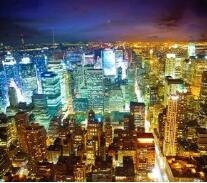
At night, climbing up onto one of the less-populated hills affords panoramic views of the city‘s night lights. Due to the city‘s hilly terrain, you can see a hierarchy of lights in all directions.
Lights in different colors sparkle and shine in layers and are reflected in the sparkling river, creating a mirage-like view -- it‘s hard to tell the river and the lights.
But it is to cruise down China‘s longest river, the Yangtze, passing through the famous Three Gorges that most tourists come to Chongqing. With over 100 cruise ships that begin their itineraries in the city, there is no better place to start a Three Gorges river tour.
Choingqing‘s hot spicy food is famous. The most well-known dish is the hotpot, which is a pot of boiling broth that you put various uncooked food items into. The meal always takes a long time, so it is good to eat it in the company of others.
Situated on the bank of the Jia Ling River, not far from its confluence with the mighty Yangtze is the ancient village of Ci Qi Kou, formerly known as Long Yin. Covering an area of some 1.2 square kilometres (291.6 acres) it is 14 kilometres to the west of Chongqing Municipality.
Chongqing itself has undergone many changes over the centuries, changes that have not been reflected in Ci Qi Kou with the consequence that the village conveys an impression of what Chongqing would have been like in the distant past. This fact has been recognized by the State Council and in 1998 Ci Qi Kou became a protected cultural site.
The history of Ci Qi Kou can be traced back for more than 1700 years. During the Ming and Qing Dynasties (1368-1911) it was famous for its production of porcelain. To date, over twenty old kiln sites have been discovered there. It is because of the importance of the porcelain industry that the name has been changed from Long Yin to Ci Qi Kou which being translated means Porcelain Village. However, the village was also an important supply post for shipping on the river, a fact that explains why there are so many shops lining the twelve lanes paved with their large flag stones that form the main routes. Here you will find many outlets for craftwork, groceries and the like as well as a horologist, photography supplies, drugstore and a tempting supply of roasted nuts and seeds. As one would expect there are also many teashops and restaurants to cater for the many visitors who come to see something of a way of life that has existed here for so many centuries.
The majority of the houses date from the Ming and Qing Dynasties, periods during which many masterpieces of Chinese architecture were created. Much of the two and three storey construction is of bamboo and timber. Blue bricks and pillars set off the snow-white walls that contrast in turn with vermilion doors and lattice windows. Black tablets and lanterns adorn the gates to complete the authentic and traditional appearance of the properties. The quietly flowing waters of the Jia Ling River pass by the front of the village and have been its lifeblood for as long as anyone can remember. For it was the river that brought goods and people here as well as carrying local products off to customers at home and abroad.
The three notable attractions of the village are the tea bars, the artists’ studios and the Shu Embroidery workshops. Surprisingly, there are more than a hundred tea bars each with their own particular characteristics. Here friends enjoy a chat or meet to discuss business. So the tea bars offer the opportunity for you to meet the locals and also become acquainted with the unique folk opera.
The ateliers, where you may see the work of the local artists will be of great interest. It has been said that the more beautiful a place may be, the more artists it will attract. You are sure to be amazed by the quality of the work on show and in progress as the many artists record the local scenes with skill and dedication. With so many artists working in Ci Qi Kou, you will be spoiled for choice when seeking a souvenir of your visit
Artistic ability of another kind will sure to please your eye when you visit a Shu Embroidery workshop. The craft is famous throughout China and the skill of the women you will observe working in the village is unsurpassed. It will be difficult to decide whether to opt for a painting or a piece of embroidery as a reminder of your visit as the choice on offer is truly stunning.
Choice is no less a problem when it comes to deciding where to take a meal at one of the many restaurants. Local dishes include Mao Xue Wang, Qian Zhang Pi and JiaoYan Huang Sheng. All come very highly recommended. You may well ask ’What on earth are they?’ It is our opinion that whichever you try, you will not be disappointed and will soon come to realise why they are so popular.
It is often said that a visit to China is a cultural experience. This is never more true than when you visit a place such as Ci Qi Kou where you will find the local residents dedicated to their traditional way of life, unaffected by modern influences to be found in the larger towns and cities. Above all, you will find a friendly welcome awaits you as the people of Ci Qi Kou share their special way of life with you for the duration of your visit.
Chongqing is the birth place of the hot pot in China. Once upon a time, it was a seasonal food designed to protect against the low temperatures and frigid winds of the winter. People would sit around a table, eat hot pot, and revel in the instant warmth that would flood their bodies. Hot pot has become more and more popular today, and it is widely enjoyed by people and regardless of seasons and regions.
Eating hot pot is a joyful experience. First, you need to choose the pot - spicy, pure or a combination of two - for the soup and dipping sauce. After the spiced soup boils with a hazy steam, fish, meat, bean curds and vegetables can be added. When the soup boils again, you can eat by dipping them in a little bowl of special sauce ¨Cbut be careful of the burning hot soup!In Chongqing, hot pot restaurants can be found everywhere and many have become very popular among the local people. Xiao Tian E (Cygnet Hot-Pot Palace) and Su Da Jie, E Zhang Men are the restaurants most suited for mass consumption. The hot pot restaurants in the Chongqing 5-star Harbour Plaza also serve decent food in a cozy environment
Introduction Surrounded by water on 3 sides, Chongqing is situated at the confluence of Yangtze River and Jialing River. With beautiful hills and mountains the "Mountain City" has long been reputed for its wonderful scenery. To its east, there is the famous Three Gorges on the Yangtze River; to its west, there are the 50, 000 stone figures sculpted on the cliffs during the Tang and Song Dynasties as the acme of perfection; in its south, the stone forests in Wansheng District seem superlatively made, yet they were created by nature; and in its north you cannot help meditating on the dinosaur fossils of 180 million years ago. The Fishing Fortress in Hechuan has long been widely known. The waterfalls, stones, forests, springs, and outdoor games in Simianshan Mountain in Jiangjing are fascinating. In the city proper. there are attractive Eling Hill, Loquat Hill, Night Scene of the Mountain City, Flowers in the Nanshan Park decorating the mountain city. The East, South, West, North, and Tongjing Hot Springs are like five pearls scattered in the suburbs. The Anti-Japanese Remains present the combat achievements in Chongqing by the Anti-fascist Allies during the Second World War. and the Red Crag Village and Geleshan Martyrs’ Cemetery bear the glorious loyalty of the revolutionary seniors. For the city itself, it came into being three thousand years ago and got its name 800 years ago. On December 8, 1986, it was appointed one of the Historical and Cultural Cities of China by the State Council.
As one of the four municipalities under the Central Government (MDUCG), there are two things in particular immediately distinguish Chongqing from the other MDUCGs (Beijing, Shanghai and Tianjin). The first, it is unusually large in area, covering 82,400 sq km, 2.4 times the total area occupied by Beijing, Shanghai and Tianjin municipalities. The 43 urban districts and counties under its jurisdiction represent three quarters the total number governed by the three other municipalities. Secondly, it is unusually large in population. At the end of 1997, 30.429 million people lived in Chongqing, equivalent to 83 percent of the total population of Beijing, Shanghai and Tianjin. In Chongqing, however, more than 80 percent of the population is rural, a figure far higher than in the other municipalities.
Thus, of all the municipalities, Chongqing has the largest area and population and the highest proportion of peasants.
HISTORY Chongqing’s history extends back at least 3,000 years, endowing it with much historical and cultural significance. Traces of man’s presence have been found from as far back as the end of the Old Stone Age 20,000 to 30,000 years ago. From the beginning of the Shang Dynasty (c. 16th century B.C.) to the close of the Warring States Period (221 B.C.), it was the capital of the state of Ba. From the Qin Dynasty through the Eastern Han Dynasty (221 B.C.-220 A.D.), it was a prefecture also known as Ba. During the Sui and Tang dynasties, (581-907 A.D.), it was known as the sub-prefecture of Yuzhou, hence its standard byname "Yu.’’ Subsequently, during the Northern Song Dynasty (960-1127 A.D.), it was renamed Gongzhou. In 1189, during the Southern Song Dynasty, Zhao Dun, later the Guangzong Emperor, was given the title Prince of Gong. Regarding this as an exceedingly joyous event, he upgraded its status to that of a prefecture and renamed it as "Chongqing’’ or "redoubled celebration,’’ the name it carries to this day.
The Ming and Qing dynasties (1368-1911) saw goods spin in and out of the city as merchants from the four corners gathered. In 1891 Chongqing became an open port and a customs house was established there. Shipping and trade and the financial and processing industries grew steadily more prosperous as the city came to link southwestern China and the upper reaches of the Yangtze River with the rest of the world. In 1929 Chongqing was formally declared a city. Following the outbreak of the War of Resistance Against Japan in 1937, the Kuomintang (KMT) moved the government from Nanjing to Chongqing. In 1939 the city was elevated to a municipality under the Executive Yuan. Beginning in 1940 it served as the wartime ``provisional capital’’ for the KMT government, becoming China’s political, economic, financial, commercial, transportation, cultural and diplomatic center. After the KMT government returned to the formerly occupied capital Nanjing in 1946, Chongqing returned to its status as a municipality under the Executive Yuan.
After the founding of the People’s Republic of China in 1949, the Southwestern Sub-bureau of the Central Committee of the Communist Party of China (CPC) and the Southwestern Military and Political Commission were set up in Chongqing. The city was made a municipality directly under the central government and continued as the political, economic and cultural center of southwestern China. After the system whereby the nation was organized into large administrative zones was rescinded in 1954, Chongqing’s status was changed to that of a city under the jurisdiction of Sichuan Province. In 1983 the central government decided to include Chongqing in the first group of cities where pilot reforms of the economic system could be tried out, its economic planning being directly supervised by the State Council. The state also gave the city provincial-level administrative powers over its economy and formally made it a foreign trade port. Since entering the 1990s China has been effecting its strategy of opening and developing the Yangtze River. Chongqing was listed as an open city. In September 1996, with the approval of the State Council, Sichuan passed administration over the cities of Wanxian and Fuling and Qianjiang Prefecture to Chongqing to govern on the province’s behalf. In March 1997, the Fifth Session of the Eighth NPC discussed and approved a resolution rescinding Chongqing’s then current status of city, declaring Chongqing a MDUCG.
Topography Chongqing may be found on the upper reaches of the Yangtze River covering the area 105x17’-110x11’ E longitude and 28x10’-32x13’ N latitude. The municipality, measuring 470 km from west to east and 450 km from north to south, borders Shaanxi Province to the north, Hubei and Hunan to the east, Guizhou to the south and its former province Sichuan to the west. Generally speaking, the land is higher in the north and south, sloping lower into the Yangtze River Valley in the center. For the most part, the terrain is characterized by low hills, mostly less than 500 meters above sea level. The municipality is home to the Daning River and is fed by the waters of the Jialing, Wujiang, Fujiang and Qijiang rivers, in addition to the Yangtze.
Chongqing has a humid subtropical monsoon climate, with little frost or snow, frequent clouds and mist, warm winters, hot summers, early springs and short autumns. The average temperature in January is 7.5 C and in July, 28.5 C, the mean annual temperature being 18 C. There is abundant rainfall, with annual precipitation averaging 1,000 to 1,400 mm. Rain is particularly plentiful in the nighttime during the weeks when spring passes into summer, giving rise to the common reference "night rain in the hills of Ba, (eastern Sichuan).’’
Natural Resources More than 40 mineral products have been found in Chongqing; 25 varieties, most importantly coal, natural gas, strontium, pyrite, halite, bauxite, mercury, manganese, barium, marble, limestone and barite, have proven reserves. With reserves of 320 billion cubic meters, it is one of China’s principal sources of natural gas. Reserves of bauxite (74 million tons), halite (300 billion tons), and strontium (1.85 million tons) lead the nation. Reserves of manganese and barium rank second and third respectively.
The areas abounds with biological variety, including more than 2,000 species of vascular plants. Some 380 animal species can be found locally, including the zibet (Asiatic civet cat), otter, clouded leopard, macaque, red-breasted golden pheasants, crown deer and other unusual wild animals. Rongchang is the nation’s famous producing base for stud hogs, and Shizhu is a famous base to raise, process and export long hair rabbits. Chongqing has over 120 river fishes. Fish farming is popular in every district and county. Changshouhu Lake and Dahonghu Lake are fish raising bases of Chongqing.
Natural Scenes Chongqing proper is surrounded by the Yangtze and Jialing Rivers, so landscape is very beautiful. It is known as a "Mountain city" and also a "River city" because its buildings are constructed on hills by the rivers. Night scene of the mountain city is a wonderful sight. The South Hot Spring Park, North Hot Spring park, Jingyunshan summer resort and Nanshan park are situated in the near suburbs and Jiangjin Simianshan forest, Wansheng Yunan Stone Forest, Wulong Furongdong Cave, Xiannushan Grasslands, Nanchuan Jingfushan Forest Park are situated in distant suburbs. Along the Yantse River there are a large number of scenic spots of mountains, rivers, forests, springs, cataracts, gorges and caves such as the mighty Three Gorges, Daninghe and Xiaoninghe River valleys, Yunyang Longgang, Fenjie Heaven Pit and Earth Crevice, Wuxi Hongcheba Grasslands and Wushan Zhiyanhe River Three-Colored Cataract. Construction of the Three Gorges dam will form a 600 kilometers long and more than 1,000 square kilometers big lake on high gorges, an excellent tourist resort will thus be set up.
Historical Sites Historical sites can be sought after in Chongqing Museum, Hongyan Memorial Hall of Revolution, Geleshan Revolutionary Martyrs Tomb, Jiang Keshek’s Residence, Zhang Zizhong’s Apartment, Lingyuan, Kongyuan and some other Wartime Capital remains. Dazu Rock Carvings is the gem of stone sculptures of the later period. Hechuan Diaoyucheng city, that is called "the place where Whip of God was broken," is one of China’s three ancient battlefields. Fengdu’s Ghost City and Ghost King Stone Carvings, Fuling’s Baiheliang (the forest of steles under water), Shizhu’s Xituoyunti, Zhongxian’s Shibaozhan, Yunyang’s Zhang Fei Temple, Liangping’s Shuangguitang Temple, Fengjie’s Baidicheng City, Wushan’s Lu You Cave and Ba people’s hanging coffins and the natural scenes of the Three Gorges add radiance and beauty to each other.
Tourism The center of the old city of Chongqing is almost completely encircled by the two arms of the Yangtze and Jialing rivers. Row upon row of buildings climb the hills beside the rivers, giving rise to its nickname the "city of hills" and the phrase "night views of the hilly city" known well both at home and abroad. When night falls, the lights of a myriad families shine like stars, climbing to the sky, where they join the star-studded dome above, the flowing water and open sky each playing off the other’s radiant beauty. Close by in the suburbs are many scenes of natural beauty, including the Southern and Northern Hot Springs and summer retreats such as Jinyun Mountain and the Southern Mountain. Further out can be found the primeval forests on Simian (Four-faced) Mountain in Jiangjin City, the Yunan Stone Forest in Wansheng, Furong (Hibiscus) Cave in Wulong County, the Gaoshan (High Hill) Grasslands on the Xiannu (Fairy Maiden) Mountain, and the Jinfoshan (Golden Buddha Mountain) Forest Park in Nanchuan City. Marvelous spectacles along the Yangtze River include the magnificent natural landscapes of the Three Gorges, the Large and Small Ninghe River Gorges in the Wushan Mountains, the Dragon’s Vat in Yunyang, the fissures and hollows carved out of the living rock with divine skill as if by a demon’s axe in Fengjie, the Hongchiba Gaoshan Grasslands and Xiabing Cave in Wuxi, and the Three-Color Waterfalls on the Ziyang River in Wushan. When the Yangtze Three Gorges Reservoir is completed, the 600-km long, 1000-sq-km manmade ``lake’’ will delight tourists with the sheer walls of the towering gorges contrasting with the even waters below.
In addition to such natural splendors, Chongqing has many fascinating reminders of man’s accomplishments, such as the Red Crag Village Revolutionary Memorial Hall
如何制作学前班数学课的ppt课件
下面,一起来解读下老师做教学课件PPT经常陷入的四大误区。
误区一 文字信息过多
从PowerPoint(PPT)的英文原意来看,Point是“要点”的意思,PowerPoint的含义可以理解为“将要点更有力地展现出来”。
有一些老师简单地认为只需将要书本内容的要点复制到PPT上就可以了,我们称之为“教材搬家”。这样的页面对于学生来说信息量过大,重点不明确,看起来比较费劲。
支招:图文并茂 解放学生的双眼
PPT的本质在于可视化,就是要把原本晦涩难懂的抽象文字转化为图表、图片、动画及声音所构成的生动场景,以求通俗易懂。
老师需要改变“复制”“粘贴”的做法,尽量在教案中归纳出关键词和关键句,可以参考以下两个原则:能用图的不用表格,能用表格的不用文字。图片要和本堂课教学内容相关,不能为了放图而放图;如果没有可用的图或表,那么尽量将文字分成条目,最好控制在5行以内,不要一大段文字堆砌在一起。
误区二 逻辑混乱
逻辑是PPT的灵魂!没有逻辑和层次的PPT,只能算是图片和文字的堆砌。有些老师做PPT的时候,习惯想到哪里做到哪里,没有很好的逻辑规划,导致学生不好理解。
支招:添加导航 增强学生的记忆
首先,老师需要先理清一堂课教学内容的逻辑,拟出PPT内容大纲。制作PPT时,可以添加导航来展示整个课件的结构,比如:
目录:一个简单明了的目录可以呈现课件的清晰脉络,使学生能够一目了然,便于抓住主要内容;
标题栏:每个页面除了标明整个PPT的标题,更重要的是要标明本章节标题和本页主题;
页码:如果方便的话也尽可能加上。
误区三 页面过于花哨
有的老师为吸引学生注意力,在制作课件时加入一些与教学毫无关系的花哨元素。
注意啦,课件上一些无关紧要的内容会使学生的注意力分散,打扰他们的思维,反而削弱课堂教学的效果哦!
支招:整齐排版,统一PPT风格
1、整体模板、色调要统一。
没有特别的需要,一般不要更改背景设置的色调或风格。如果想要有层次感,可以采用同一背景色的不同渐变,保持色彩协调;
2、字体能统一的尽量要统一。
如果一张页面中出现了三种以上的字体,就会显得有点乱了,尽量控制在1-2种字体;
3、选择的素材跟教学内容相关。
现在网络资源很丰富,老师在制作课件时可以选择多样的素材。但是,这些素材一定要与教学主题相关,不然会造成两个后果:一是课件看起来很乱,二是分散学生注意力;
4、不要使用很复杂的动作设置、动画方案。
页面切换时应慎用花哨动作和无关声音,特别是在需要学生思考问题的时候,突然出现与教学内容无关的切换声音,容易打乱学生思维,分散注意力。在讨论比较轻松的话题时可以加上一些效果,但都不宜超过两种。
误区四 做完PPT不测试
有一些老师在做完PPT之后就觉得已经完工了,其实还有最重要的一个步骤——进行现场测试。如果漏掉这一步,之前的辛苦努力都很有可能白费~~
支招:现场测试 保证课堂效果
检验版本是不是兼容。PPT软件有几个版本,在自己的电脑上完成制作后,要到录制现场进行测试,可以知道版本是否兼容,确保可以正常演示;
检验PPT里超链接和动作效果的正确性。有的课件存在大量超链接和动作效果,如果不进行现场测试,在正式场合使用时可能会暴露各种问题,比如出现死链或者不应有的动作效果,那时再修改就来不及了;
对比电脑和大屏幕的效果。在电脑上的效果和用投影仪展示的视觉、听觉效果存在一定的差别。特别是有多种颜色对比、重叠、交叉时,往往在电脑上看起来效果很好,学生却在大屏幕上看不清楚文字和色彩的对比效果。这时,现场测试就显得特别重要。
本文相关文章:
2026年5月16日 02:41
2026年5月15日 23:28

网页模板模板之家(有谁了解ASPCMS模板之家,ASPCMS模板之家的服务怎么样)
2026年5月15日 21:01
2026年5月15日 20:56
2026年5月14日 16:04

公司主题商业网站模板(求一些高大上的公司网站链接,主求漂亮的公司网站主页模板)
2026年5月14日 02:02
建筑模板价格多少钱一张(建筑工程模板成本有多少——1-5元/㎡)
2026年5月13日 06:28
2026年5月13日 02:20
2026年5月12日 18:30
2026年5月12日 15:34
更多文章:
2026年5月9日 00:03
2026年4月19日 08:43
2026年6月7日 16:12
新站SEO优化简历如何突出重点:如何用SEO优化简历在新站中脱颖而出
2026年6月7日 22:48
2026年4月14日 10:43
vivo获嘉服务网店在哪?中国联合网络通信有限公司获嘉县分公司怎么样
2026年5月10日 16:30
2026年5月2日 06:34
义乌市创博网络科技有限公司(海宁到浙江创博汽车部件科技有限公司坐什么公交车)
2026年4月24日 22:00
2026年5月9日 06:15
2026年6月5日 00:00
泰州做企业网站建设多少钱:泰州网站建设泰州做企业网站建设多少钱
2026年6月14日 23:00
新手做seo实训报告表格的步骤:新手如何一步步完成seo实训报告表格
2026年6月17日 14:39
2026年5月11日 04:47
2026年4月24日 14:25
2026年4月24日 11:43
自助建站网站设计需要考虑哪些要素:自助建设网站的设计如何选择合适的模板
2026年6月21日 00:27
2026年6月3日 01:15

2026年4月29日 08:39
2026年5月4日 16:14
2026年4月14日 17:06